
1. When You Hit a Wall in Meditation
Setting aside time every morning to read and meditate on the Word is a precious practice. However, it isn’t always a smooth, flowing stream of grace. As you meditate, there comes a moment when you hit a massive wall or reach a limit. This usually happens when you read a passage over and over but have absolutely no idea what it means.
When the context feels disjointed, the words are ambiguous, and the text seems completely disconnected from reality, we often feel flustered. We might exhaust ourselves trying to squeeze out a forced meaning, and eventually, we simply close the Bible in frustration, saying, “That’s it for today.”
2. We Are Not Theologians
In these moments, the very first thing we must remind ourselves is this: “We are not theologians.”
The Bible was written thousands of years ago in a language, culture, and historical context entirely different from our own. It is naturally impossible for a layperson—who is unfamiliar with Ancient Near Eastern customs or the historical backdrop of the time—to instantly grasp every verse of scripture. Not knowing is perfectly normal. Just because enlightenment doesn’t strike immediately, there is no need to condemn your spirituality or your ability to meditate. Nor should you force the text to fit by relying on your own imagination.

3. Seek Help from Trusted Commentaries
Therefore, when the path of meditation is completely blocked because the meaning is unclear, do not force it. Instead, reach for proven tools. Consult a reliable commentary or a Study Bible.
Resources like the ESV Study Bible, the IVP Bible Background Commentary, or N.T. Wright’s highly accessible For Everyone series serve as excellent guides. These trusted commentaries accurately point out the historical background of the time, the original nuances of the language, and the author’s true intent. With the help of a sound commentary, a verse that felt like a dead end becomes clear, and your drifting meditation can once again flow toward a deep well of grace.
4. Beware of Turning It into an Academic Bible Study
However, once you open a commentary, there is a critical trap you must beware of: do not dig too deep.
Reading a commentary naturally stimulates your intellectual curiosity. You might feel the urge to unearth more historical facts or dissect the grammar of the original language. Before you know it, your time of “meditation”—which is meant to be fellowship with God—vanishes, turning into a “Bible study” session where you are merely accumulating head knowledge.
Our ultimate goal is not to acquire fragmented pieces of information about the Bible. It is to hear the voice of God speaking into our lives today through His Word. Commentaries should be used strictly as a minimal guideline to keep us from misinterpreting the text or wandering down the wrong path.
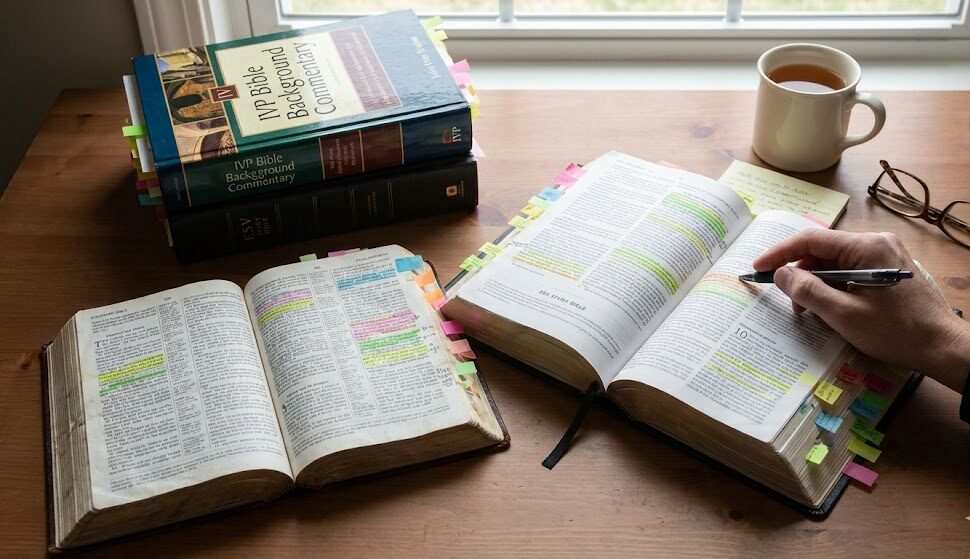
5. Returning to the Quiet Place of Meditation
Once the commentary has helped you understand the meaning of the blocked passage, close it without lingering. Take that newly understood Word, embrace it in your heart, and return to the quiet place of meditation before God.
“God, how should this Word be applied to my daily life and my relationships today?”
The true deepening of meditation does not lie in accumulating vast amounts of knowledge. It lies in narrowing the distance between the Word and your life, until eventually, the Word becomes your life. When you hit a limit, if you use tools wisely while holding fast to the core essence—your conversation with God—your meditation will step into a much deeper and infinitely richer realm.